HomePolitics
Politics
She Worked For A Charity Later Shut Down For Terror Financing — And Court Exhibits Mention Her Fourteen Times
Advertisement
above-image
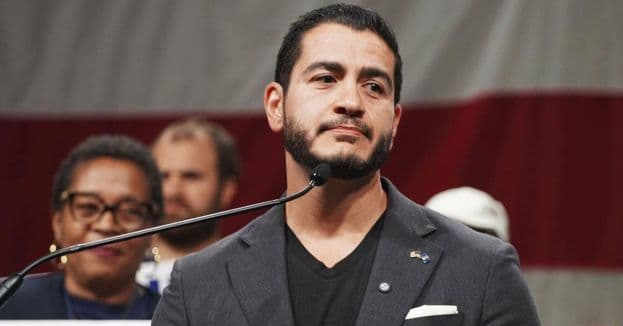
The Federal Bureau of Investigation once raided the home of the mother of left-wing Michigan Senate hopeful Abdul El-Sayed, an episode dating back to the early 2000s and apparently tied to a terror-financing probe that shuttered the Islamic charity where she worked, according to the candidate’s half-sister.
Advertisement
after-intro
According to the Washington Free Beacon, the episode surfaced not through law enforcement disclosures but in the writings of El-Sayed’s sister, University of Chicago professor Eman Abdelhadi, who has repeatedly described her family’s encounters with federal agents. Abdelhadi, the daughter of El-Sayed’s Egyptian-born mother, Fatten Elkomy, first alluded to the raid in a June 2016 essay recounting her experience at a New York City vigil for the victims of the Pulse nightclub massacre, where she took issue with the rhetoric of then–New York governor Andrew Cuomo. Cuomo had pledged to "do what we did after 9/11" and "build back a monument better than ever before," language that, for Abdelhadi, triggered memories of what she characterizes as state overreach against Muslims in the post-9/11 era.
 Obama Mocks Hegseth’s ‘Jawlines And Testosterone’ Focus—But His Real Fear Runs Deeper
Advertisement
inarticle
"I flashed back to memories of the FBI raiding mosques, homes—including my own—and Muslim charity organizations," Abdelhadi wrote, invoking a personal history that complicates her brother’s political narrative. "If the crowd remembered how the state had imprisoned thousands of Muslims after 9/11, it certainly did not show it or did not care." She offered no further details about the raid in that 2016 piece, leaving unanswered questions about the timing and scope of the FBI’s actions against her family.
Abdelhadi later expanded on her experiences with federal scrutiny in an August 2024 article for Zeteo, pointedly titled, "I Tweeted Chicago Protesters Were 'Ready' for Harris. Then, I Got the Call From the FBI." In that essay, she framed FBI attention as a near-constant backdrop to her upbringing, explicitly linking it to her mother’s work for an Islamic charity that would later be accused of funneling money to terrorist organizations. "As a Muslim, I am no stranger to FBI surveillance," Abdelhadi wrote, casting herself as part of a broader Muslim community she believes has been unfairly targeted.
Advertisement
inarticle
She went on to describe her mother’s employment at a charity that, in her telling, focused on humanitarian relief. "When I was a teenager, my mother worked for an Islamic philanthropic organization that delivered humanitarian aid to orphans and refugees worldwide. It was one of at least nine muslim philanthropic groups closed by the FBI in the early 2000s." The picture she paints is of a household living under the shadow of potential law enforcement action, with her mother constantly bracing for the possibility of another raid.
"Between work, school, and mothering was the FBI," she continued, underscoring the extent to which federal scrutiny shaped daily life in their home. "I remember watching her comb through our house, our books, our CDs, our cassette tapes for anything that might be misinterpreted if our house got raided," Abdelhadi wrote of her mother, who is also El-Sayed’s mother. "She fielded calls from the FBI every once in a while. I can picture her face after those calls, terrified but defiant. We learned to whisper even in our homes, to be careful what we said over the telephone."
The organization Abdelhadi was describing is the Islamic American Relief Agency (IARA), a Missouri-based nonprofit where Elkomy worked from 1999 through at least 2004. That year, the Treasury Department designated IARA’s "worldwide network" for financing terrorism, including the precursor organization of al-Qaeda, the Taliban, and Hamas, and the group was subsequently shut down. The FBI raided IARA’s Columbia, Missouri, office—where Elkomy was employed—on Oct. 14, 2004, an event documented by the Columbia Daily Tribune, which reported that "federal agents interviewed Elkomy, 44, for about three hours yesterday. 'All the conversation was trying to find how we do work and how I do work,'" Abdelhadi told the paper, reflecting the family’s insistence that their activities were benign.
While the precise date of the raid on Elkomy’s home remains unclear, the timing strongly suggests it was linked to the broader IARA investigation. Both the FBI and the Department of Justice declined to respond to inquiries about the home raid, leaving the public to rely largely on court records and family accounts. For a candidate seeking high office, such gaps in the record raise obvious questions about transparency and vetting, particularly when national security and terror financing are involved.
The Department of Justice ultimately charged IARA’s U.S. branch in 2007 with illegally transferring funds to Iraq, and search warrants tied to the case remain sealed to this day. Court exhibits filed in the matter mention Elkomy 14 times and document her role in eight wire transfers, including a $24,607.34 transfer to IARA’s Iraq office, while also referencing phone calls in which she allegedly solicited money for the group’s Iraqi operations, according to records first highlighted by the Midwesterner. Although Elkomy was never charged with a crime, prosecutors listed her as a potential witness they expected to subpoena to testify about her "work at IARA," but a trial never took place because two IARA board members and the organization itself entered guilty pleas.
These documented interactions with federal authorities stand in sharp contrast to the benign portrait of his mother that El-Sayed has offered on the campaign trail. The Democratic candidate has come under fire from republican opponent Mike Rogers not only over his mother’s ties to IARA but also over her "activism in the Muslim Brotherhood during the early 70s when she was in college," as Abdelhadi herself described it in a June 2012 tweet. For voters concerned about Islamist influence and national security, such disclosures are hardly trivial, especially when they come from within the candidate’s own family.
El-Sayed has attempted to brush off these concerns as politically motivated smears. "He keeps raising this question about this association with an organization I've never been a part of because of my mom who's a nurse in Missouri?" El-Sayed said during the candidates’ final debate on Wednesday, casting his mother as an ordinary health-care worker rather than a longtime employee of a charity later implicated in terror financing. His framing omits the extensive public record surrounding IARA and the federal government’s findings about its activities.
Elkomy, who attended Alexandria University’s school of medicine in Egypt, continues to reside in Missouri, where she is employed by The Islamic School of Columbia. In her 2012 interview following the IARA raid, she denied any knowledge of wrongdoing, but counterterrorism consultant Evan Kohlmann, an expert witness in the IARA case, told the New York Times that "the charity was so small that all of its employees most likely knew about its activities." His assessment suggests that ignorance would have been difficult to maintain in such a tightly run operation.
"It was no secret that they were doing this," Kohlmann said, referring to the group’s financial support for Osama bin Laden. One IARA employee, for instance, obtained a satellite phone for bin Laden during a 1997 business trip funded by the charity, a device the al-Qaeda leader used to coordinate attacks on U.S. embassies, according to the Department of Justice. For a Senate candidate whose party often downplays the threat of radical Islam, the proximity of his family to such an organization is bound to alarm voters who prioritize national security and vigilance against terrorism.
Neither El-Sayed’s campaign nor Elkomy nor Abdelhadi responded to requests for comment about the family’s history with IARA and the FBI. Their silence leaves a vacuum that is being filled by court documents, contemporaneous news reports, and Abdelhadi’s own writings, all of which paint a more complicated picture than the sanitized biography typically offered by progressive campaigns. For conservatives wary of ideological extremism and foreign entanglements, the lack of forthright answers is itself a red flag.
The family’s interactions with the FBI did not end with the IARA investigation. In her 2024 Zeteo article, Abdelhadi recounted being contacted by the bureau after she posted incendiary tweets about then–vice president Kamala Harris ahead of Harris’s visit to Chicago for the 2024 Democratic National Convention. "Oh Kamala is NOT ready for Chicago," Abdelhadi wrote. "But don't worry; we're ready for her."
Her rhetoric drew enough concern that federal agents reached out. "On Friday morning, I got a voicemail from the FBI. When my phone rang and Apple registered it as the 'US Government,' I knew exactly who it would be," Abdelhadi wrote, describing how Harris supporters had flagged her posts as threatening. "For the past week, Kamala Harris supporters have been bombarding my social media pages with proud declarations that they?d reported me to the federal government as well as my employer for 'threatening the Vice President.'" She dismissed those concerns as rooted in bigotry, writing, "My post would not have been considered threatening if I were not Muslim or Palestinian." (Elkomy married Abdelhadi’s father, a Palestinian man, after divorcing El-Sayed’s Egyptian-born father.)
Abdelhadi has since leaned into her reputation as someone on the FBI’s radar. One year later, in March 2025, she wrote about her role in anti-Israel protests at the University of Chicago, boasting, "Wanna call the FBI? I already have a file, baby. Trouble at the border? I and everyone in my family has already gotten additional screenings … for decades." Her comments reflect a posture of defiance toward law enforcement and border security, positions that sit uneasily with voters who favor robust policing and strict immigration controls.
On the campaign trail, El-Sayed has tried to distance himself from his half-sister’s statements and from her claims about their family’s Muslim Brotherhood ties. In a recent interview with NBC’s Tom Llamas, he dismissed Abdelhadi’s tweets as unreliable. The posts, which resurfaced in a Washington Free Beacon report, emerged shortly after El-Sayed told Meet the Press that neither he nor his family members have any connection to the Brotherhood.
"I have never had these conversations with my mother," said El-Sayed, rejecting the notion that his family has Islamist affiliations. "Like, you're using hearsay evidence from a tweet. This is not serious." His attempt to discredit his sister’s account, however, clashes with the documented record of her close relationship with him and her detailed recollections of their shared upbringing.
Despite his public efforts to minimize their connection, evidence suggests that El-Sayed and Abdelhadi maintain a personal bond. In 2020, he sent her money via Venmo to contribute to a birthday gift for their mother, a small but telling sign of ongoing family ties. Years earlier, he served as her guardian at her 2016 wedding, which was conducted under Sharia law and featured Elkomy, as previously reported by the Free Beacon, underscoring that this is not a distant or estranged relative but a central figure in his extended family.
For her part, Abdelhadi has been effusive in her support for her brother’s political ambitions. "The feeling when you think you’ve accomplished a lot but then your older brother runs for senate!!!" she wrote in an April 2025 tweet, celebrating his campaign. "In all seriousness—Abdul is fighting for healthcare, housing, and an economy that serves people over oligarchs. I am a proud little sister." Her praise highlights the ideological alignment within the family, with both siblings embracing a progressive agenda that prioritizes expansive government programs and class-based rhetoric over the free-market principles and limited government favored by conservatives.
Taken together, the record surrounding El-Sayed’s family—his mother’s work for a charity later tied to terror financing, his sister’s own admissions about FBI raids and surveillance, and the unresolved questions about Muslim Brotherhood activism—raises serious concerns about judgment, transparency, and ideological leanings. For a candidate seeking to represent Michigan in the U.S. Senate, these are not peripheral biographical curiosities but central issues that bear directly on national security, foreign policy, and the broader question of whether voters can trust his assurances. As republicans press for answers and Democrats largely look the other way, Michigan voters are left to weigh a troubling paper trail against a campaign narrative that insists there is nothing to see.
Advertisement
article-bottom-1
Advertisement
article-bottom-2